Why Your Bridge Pose Isn’t Working (And 3 Fixes That Change Everything)
Apr 22, 2026The other day in class, one of my students came up out of Bridge and just paused for a second.
She looked at me and said, “That felt… different.”
Same pose. Same body. But everything about it had changed.
Her lift was higher, yes. But more than that, it looked organized. Supported. Like her body actually knew what it was doing instead of just pushing up and hoping for the best.
And I’m seeing this across the board right now in the online studio.
Backbends that used to feel heavy are starting to feel strong. Students are coming down from Wheel with control instead of collapsing. Bridge Pose, of all things, is becoming the place where everything clicks.
That’s because we’re treating it like it matters.
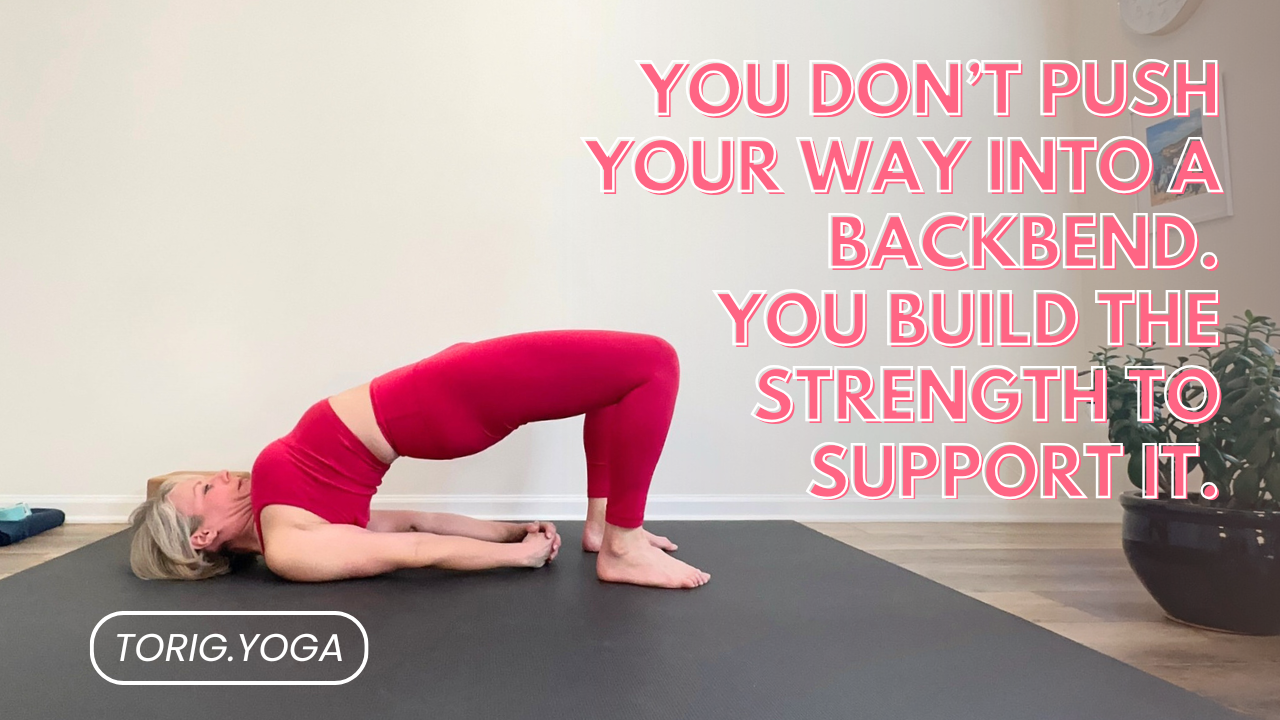
Bridge Pose isn’t just something you do on the way to something else. It’s where you build the strength and awareness that makes every other backbend possible.
If your backbends have felt stuck, inconsistent, or all in your low back, this is the place to look.
Here are the three things we’ve been focusing on that are making the biggest difference:
First, press your triceps down into the floor.
When the arms stay passive, the shoulders sink and the chest never really lifts. The moment you start actively driving your triceps into the mat, your upper back turns on. Your chest lifts higher, your weight evens out, and your low back stops taking on all the work. The pose starts to feel supported instead of compressed.
Second, when you look down your centerline, your abdominal wall should be flat, not domed.
This is your feedback system. If your belly is pushing up and out, your core has checked out and your spine is taking over. When the abdominal wall stays integrated and flat, the whole shape becomes more contained and controlled. You feel steadier. Stronger. More in charge of the movement instead of reacting to it.
Third, your toes point straight forward and your inner thighs are working.
When the feet turn out, the hips follow, and the stability disappears. Keeping your toes forward and actively engaging your inner thighs brings your adductors online. That support feeds directly into your pelvis and low back and changes how the pose feels from the ground up.
This is the work that changes everything.
It isn’t flashy. It doesn’t always look impressive from the outside. But it builds the kind of strength that carries into your Wheel, your standing backbends, and the way you move through your life off the mat.
I’ve been there, too. There was a time when my backbends felt like something I just survived. I pushed up, held on, and hoped my body would cooperate. It wasn’t until I slowed down and actually trained the pieces that everything started to shift.
That’s the invitation here.
Take your time with this. Get curious about what you feel. Build the strength that supports the shape instead of chasing the shape itself.
Because that moment when it finally clicks?
It has nothing to do with how deep you go.
It has everything to do with how strong you feel when you get there.
Author