Why a Deep Backbend Shouldn’t Make You Think “Ouch”
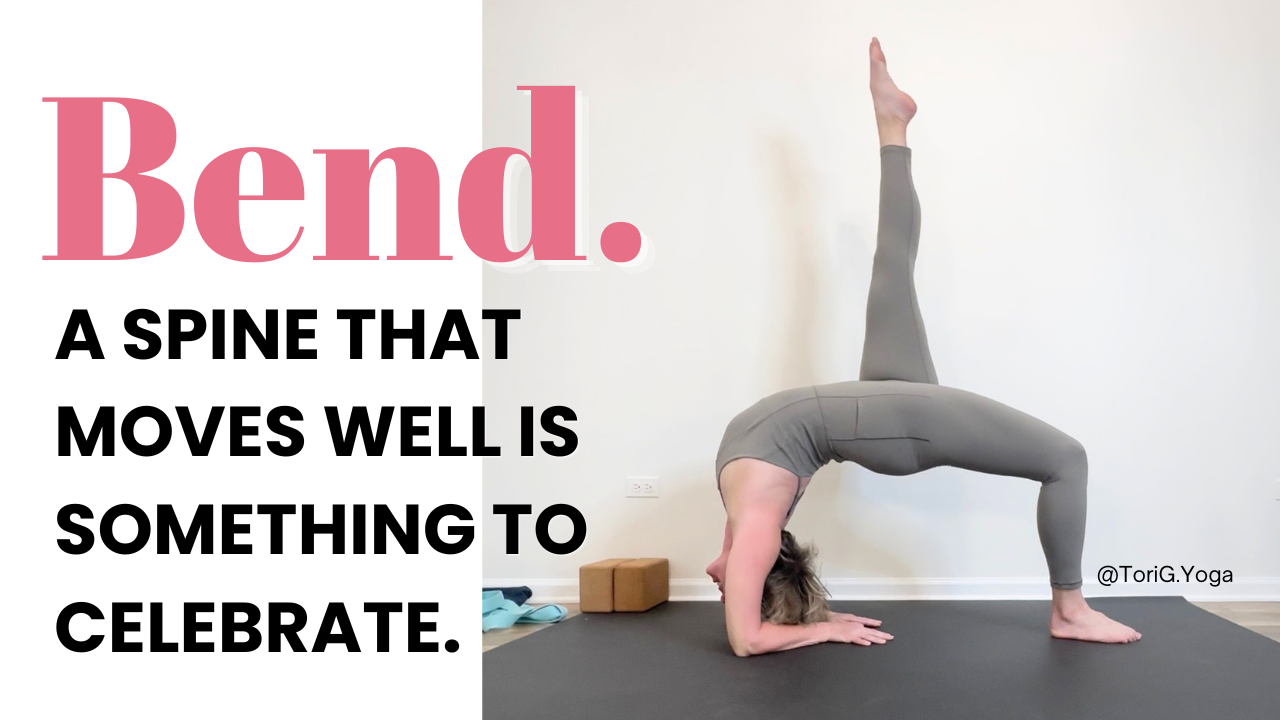
Aug 09, 2026For at least 15 years, I’ve been able to predict one comment every single time I post a photo of myself, or one of my students, in a deep backbend.
“OUCH.”
Sometimes they really commit to it. OUCCCHHHHH.😂
It still makes me laugh because the person actually IN the backbend is usually thinking anything but ouch.
If you’ve practiced yoga for a while, you probably know the feeling I’m talking about. You come into a backbend and everything is working. Your legs are strong, your upper back opens, your chest lifts, your breath is there, and suddenly the whole shape feels spacious instead of compressed.
There is nothing “ouch” about it.
So whenever someone leaves that comment, I always want to respond, “You mean… LOOK AT THAT HEALTHY SPINE?”
Because THAT is what I see.
Your Spine Was Made to Move
A healthy spine isn't one that we never bend, twist or challenge. Our spines are designed to flex, extend, rotate and bend from side to side, and maintaining access to those movements as we get older is something worth celebrating.
I have zero interest in spending the second half of my life slowly removing movements from the list of things my body can do.
That doesn’t mean we approach movement recklessly. In fact, I think the opposite becomes true as we get older and accumulate more years on the mat. I want to understand my body better, become more skillful with how I move it and continue building the strength and mobility that allow me to explore bigger ranges of motion.
And that brings me to the part of this conversation that matters most.
Proper Backbending Technique Is a Must
A good backbend isn’t simply about how far you can go, and it definitely isn't about throwing yourself backward and hoping your lumbar spine figures it out.
There is a LOT happening in a well-executed backbend.
Where the extension is coming from matters. What your pelvis is doing matters. How you’re using your legs and glutes matters. The mobility of your upper back and shoulders matters. Your breath matters.
As the backbend gets bigger, understanding how all of those pieces work together becomes even more important.
This is also where I have oodles of knowledge.
After more than 20 years of practicing and teaching yoga, I have spent a LOT of time studying, practicing and teaching backbends. I’ve helped people learn how to find more extension without asking the same few places to do all of the work, create strength and support inside the shape, and recognize the difference between the intensity that can come with a big backbend and a sensation that tells us something needs to change.
That last piece is especially important.
The goal is never to become better at ignoring your body so you can make a bigger shape. The goal is to become so good at understanding your body that you know how to respond to what it's telling you.
The Pose Isn't Enough
Unfortunately, this level of back bending technique isn’t always taught in your average yoga class.
We’re often taught the shape without being taught enough about HOW to create it.
You may be told where to put your hands and feet, where to look and what the finished posture should resemble, but there is an enormous difference between getting your body into the general shape of a backbend and understanding how to organize your body once you're there.
I think that distinction matters even more for those of us who have been practicing yoga for years.
At this point, I don’t just want to be able to do the pose. I want to understand it.
I want to know where I can create more space, where I can build more strength and how I can make the entire shape work better. That’s how I want to practice at 49, and it’s how I want to be practicing at 59, 69 and beyond.
I Don't Want to Do Less as I Get Older
This is one of the reasons we spend so much time on the details inside my online yoga studio for women over 40.
I love taking a pose you may have practiced hundreds—or thousands—of times and showing you something that suddenly makes it feel completely different. Sometimes it creates more range. Sometimes it helps you find strength you weren't using before. Sometimes you realize you've had another option available to you all along.
That’s the kind of progress I’m interested in now.
After all these years on the mat, I’m definitely not looking to simply maintain what I already have. I still want to learn things. I still want breakthroughs. I still want to find out what my body is capable of next.
And I want the same for you.
So the next time somebody sees your backbend and says “OUCH,” you and I can just smile.
Because we know better.
Damn. Look at that healthy spine.
And if you’re reading this thinking, Okay Tori, I want my backbends to feel that good, I have something for you.
I created 3 Secrets to Effortless Backbends to help you understand some of the things that can make a huge difference in how your backbends feel—not just how they look.
It’s completely free, and it’s a great place to start if you want to create more space, strength and freedom in your back bending practice.
Author